CoreOS Linux Hits Day 1000
March 28, 2016
Originally published on the CoreOS blog (archived copy) .
This past weekend we shipped CoreOS 1,000. Each release version number is a count of the days since the CoreOS Epoch, July 1, 2013. Sunday’s release marks 1,000 days of CoreOS Linux.
We started CoreOS with the mission to secure the infrastructure that powers the Internet. Like Chrome made the front-end of the Internet more secure by bringing automatic updates to the Web browser, CoreOS Linux made the back-end of the Internet more secure by delivering automatic updates to servers and clusters. Since common practice is to set up a server and never touch it again, we believe the only way to secure the Internet is to provide automatic software updates to the server.
We started on this journey in 2013 with CoreOS Linux. 1,000 days later, the community surrounding CoreOS has grown enormously. In just the last month we have provided software updates and patches to over a quarter of a million servers to companies as varied as Verizon, International Securities Exchange, and more.
The most outstanding benefit of this automatic update philosophy is the pace at which we can deliver fixes for security vulnerabilities as they surface, from infamous flaws like Heartbleed and Shellshock, to others that CoreOS helps you to never worry about. Since the beginning of 2016, security vulnerabilities have arrived fast and furious; notably, GRUB (January 14, 2016), the Linux kernel keyring leak (Jan 20, 2016), OpenSSL Logjam (February 1, 2016), and OpenSSL DROWN (March 4, 2016). An atomically and automatically updating operating system is a necessity in today’s increasingly hostile computing environment.
Reflecting on major events in our namesake project, CoreOS Linux
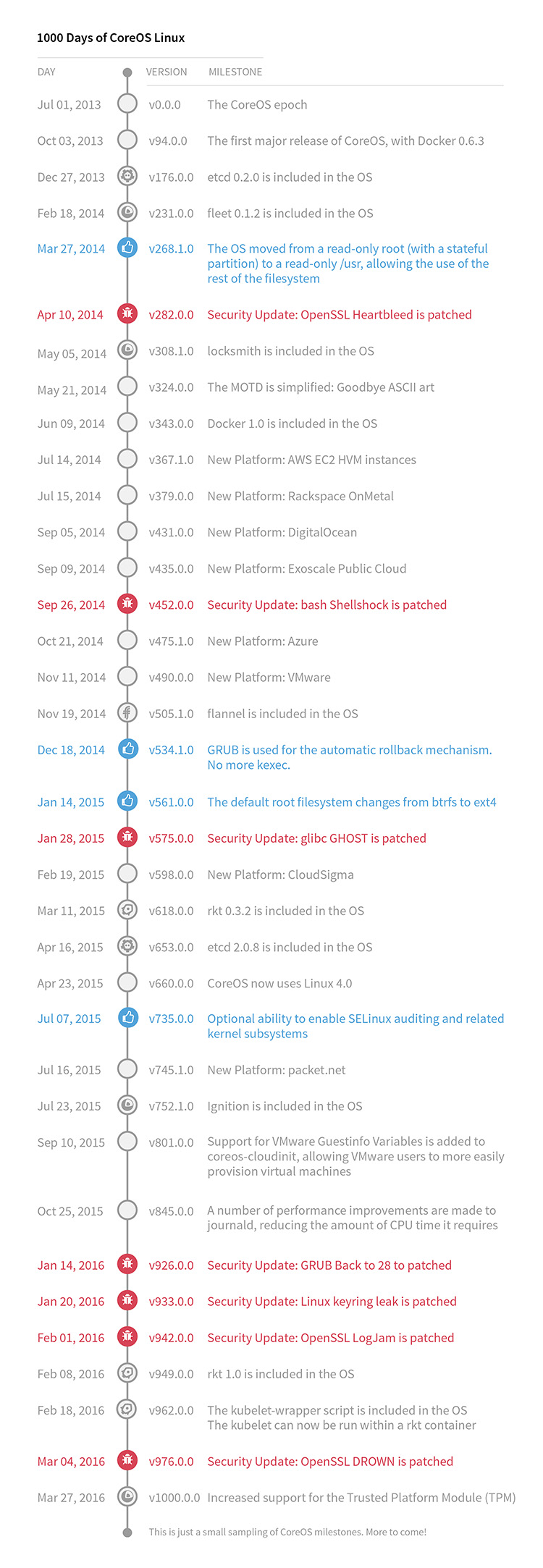
Below is a timeline of events and milestones that we are reflecting on as we celebrate version 1,000 today. Our first major release of CoreOS Linux happened in October 2013, and then we added the foundational etcd distributed key-value store (Dec 27, 2013), fleet (February 18, 2014), flannel (November 19, 2014), and the latest addition, the rkt container engine (March 11, 2015). Along the way, we made CoreOS Linux available on many different platforms and providers, such as AWS (July 14, 2014), Rackspace OnMetal (July 15, 2014), Digital Ocean (September 5, 2014), Azure (October 21, 2014) and more. Check out our version 1,000 timeline for more of the history of CoreOS Linux.
Thank you to the CoreOS Linux community
Thank you for supporting us over the last 1,000 days and as we continue to grow and secure the Internet. To celebrate we are asking all users of CoreOS Linux to share your favorite things about CoreOS Linux by tweeting (include #CoreOS1000) or by sharing direct feedback through our short Google Form. We’ll follow up with a CoreOS package of love — a CoreOS sticker and shirt.
To learn more about CoreOS Linux, join the community or meet the people behind your favorite CoreOS projects join us at CoreOS Fest in Berlin on May 9 and 10 or at our satellite event in San Francisco on May 9.